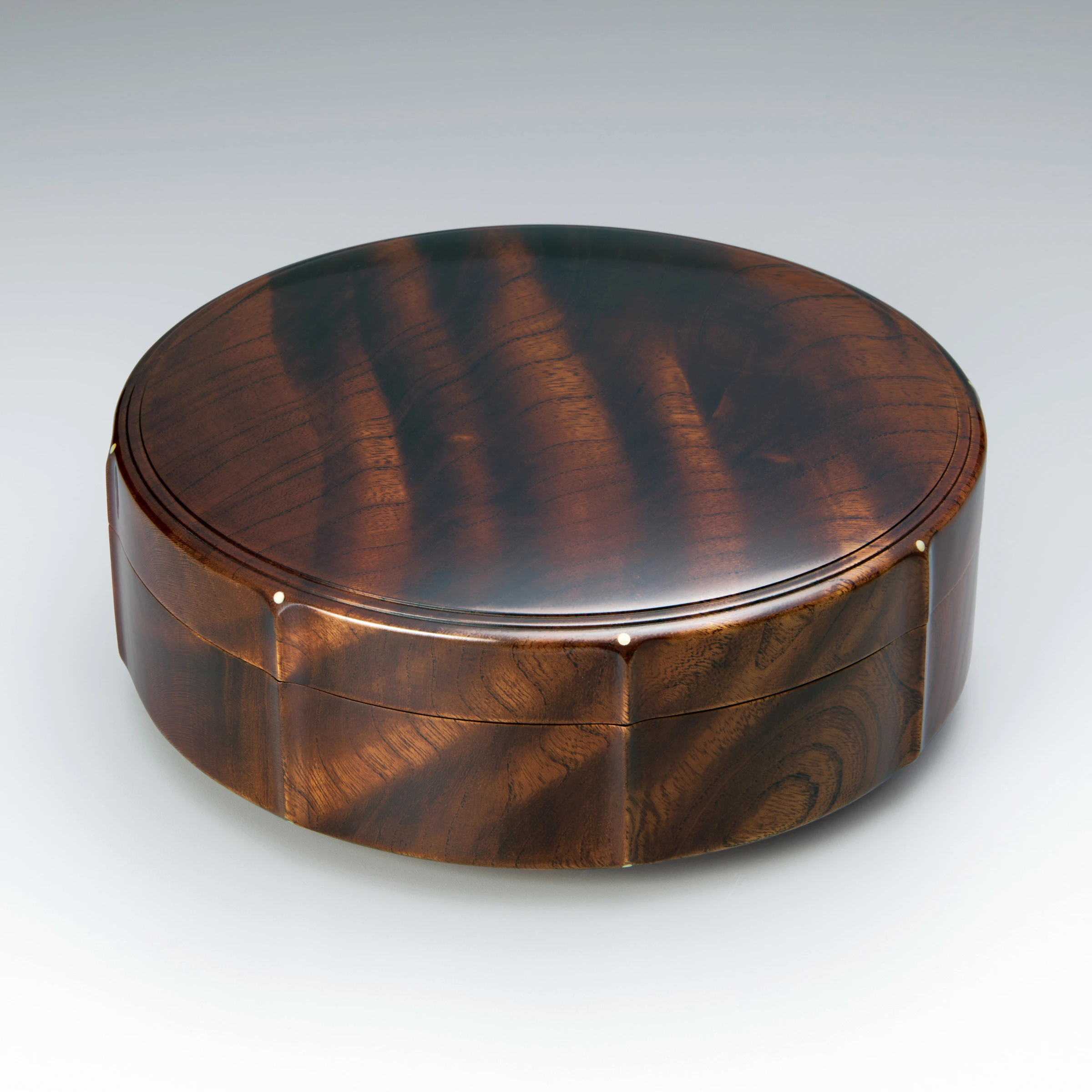
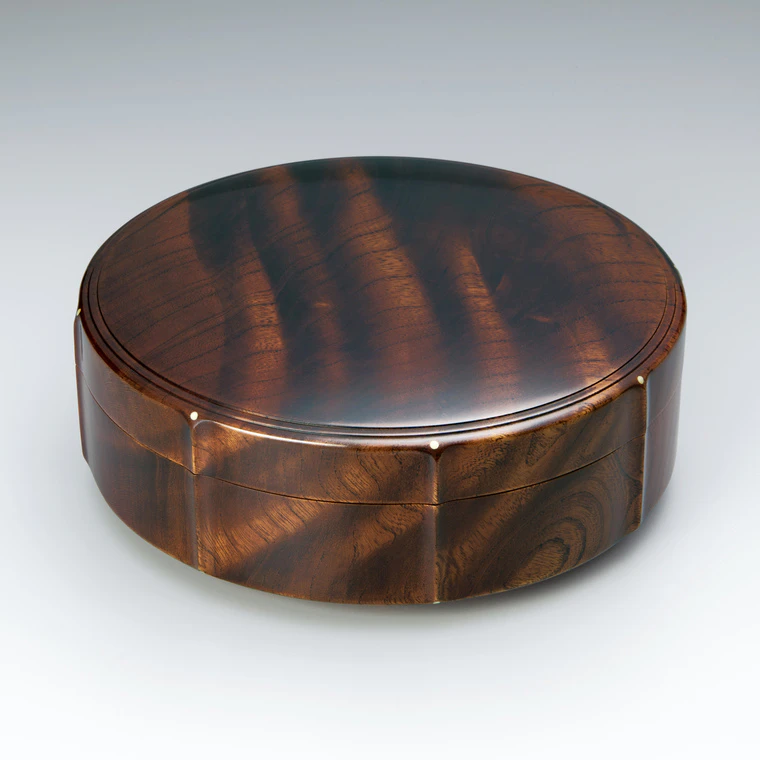
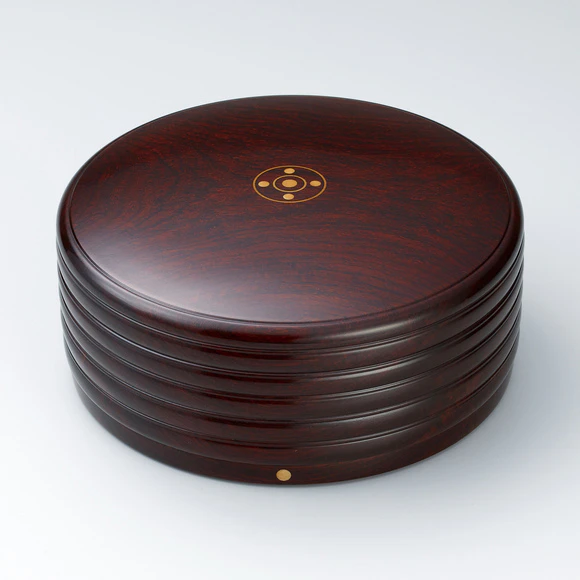
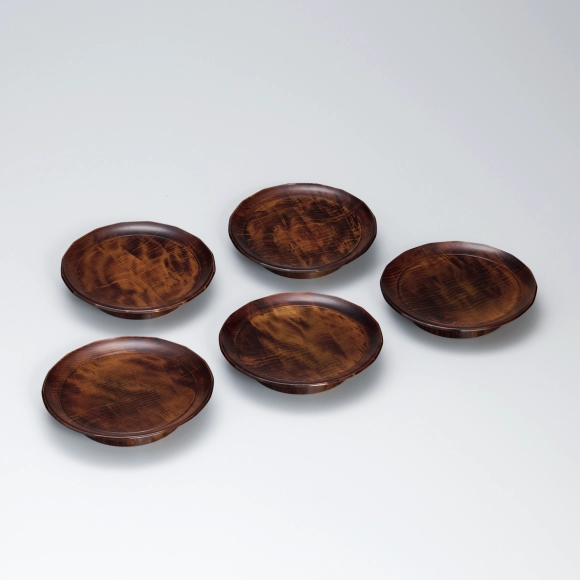
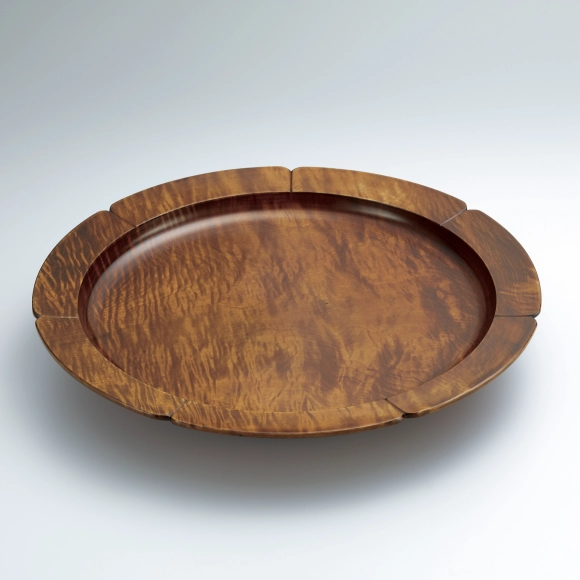
Covered Vessel of Zelkova Wood with Eight Ridges Finished in Wiped Urushi
H 9.0 / ø 24.0 cm,Year.2025- Wood and Bamboo
- Price Range Please Inquire
About the Artwork
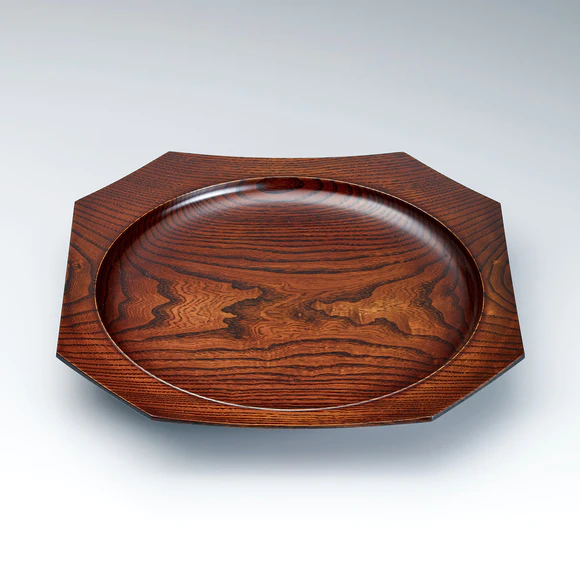
I used zelkova wood near the root and finished it with wiped urushi to bring out a well balanced gradation of the wood grain. In wood turning, the wood becomes a concentric circle as it is formed on a rotating lathe, but I wanted to make something different using hollowing techniques, and made a covered vessel with eight ridge lines on the side. I inlaid ivory on the top and bottom of the ridge lines as an accent.
Description
-
CategoryWood and Bamboo
-
Materials
-
DimensionsH 9.0 / ø 24.0 cm
-
Year presented2025
-
RarityUnique
Techniques Used
Hollow work
In hollow work (kurimono), gouges and chisels are used to hand-carve hollow vessels from a block of wood. Complicated curves and rounded forms are a common feature of hollow work.
Wood turning
In wood turning (hikimono), a piece of wood is rotated on a lathe and shaped with various cutting tools. Wood turning is suited to the creation of round trays, containers, and bowls. Different blades and cutting angles can be used to produce a wide range of forms. Balanced, symmetrical forms are made by spinning the lathe at a constant speed.
Wiped lacquer finish
Wiped lacquer (fuki urushi) is a wood-finishing technique consisting of a thin coat of lacquer. The lacquer is applied with a spatula or brush, rubbed in with a cotton cloth, and then wiped away using washi paper or clean fabric. Repeating the process numerous times produces a finish that brings out the wood’s grain and texture.
Selected exhibitions
- The 20th Wood and Bamboo Traditional Kōgei Exhibition (2025)
- Selected