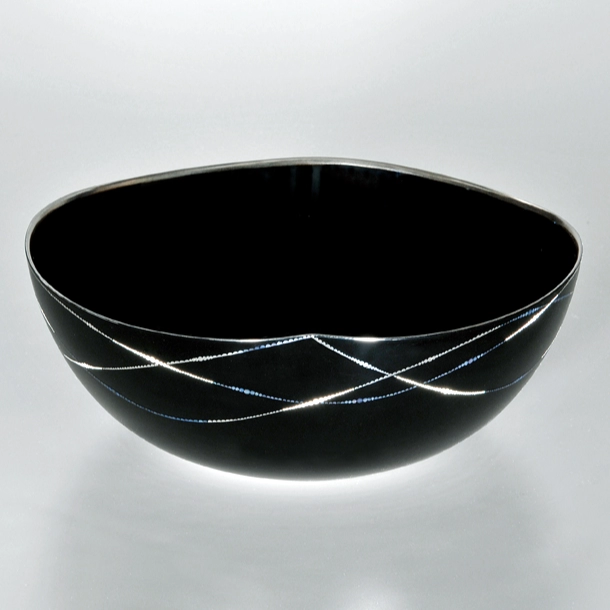
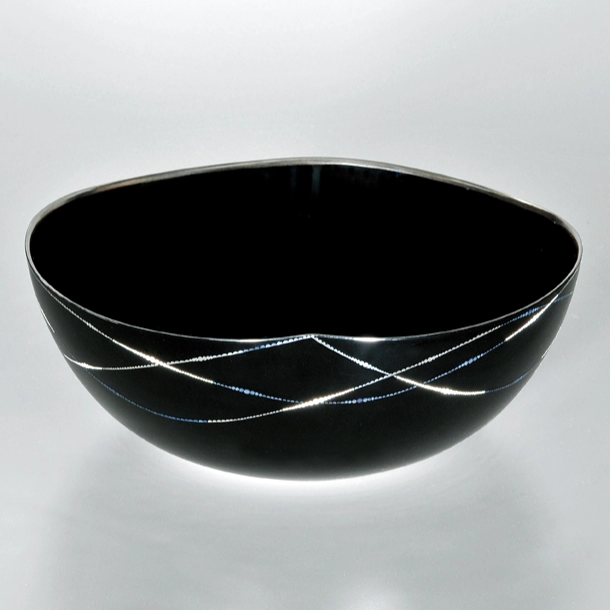
Dry lacquer container "North wind"
H 15 / ø 30 cm,Year.2014Shunsuke Inoue
1983 -- Lacquerware
- Awarded once at the Japan Kōgei Assoc. Exhibition
- Price Range Please Inquire
About the Artwork
The winter winds blowing down from the mountains in the basin of the Tohoku region of Japan. This work expresses the cold, harsh, yet beautiful richness of nature.
Description
-
CategoryLacquerware
-
Materials
-
DimensionsH 15 / ø 30 cm
-
Year presented2014
-
Production period4 months
-
RarityUnique
Techniques Used
Dry lacquer
For works of dry lacquer (kanshitsu), first a clay form is created and plaster is used to take a mold of the form. Next, repeated layers of hemp cloth and lacquer are applied to the mold until they are built up to the desired thickness. Finally, the mold is removed and additional coats of lacquer are applied to finish the piece. The hemp fibers are strengthened when the lacquer bonds with them, making dry lacquer an excellent technique for creating sturdy forms with a significant degree of freedom.
Metal sheet inlay
Metal sheet inlay (hyōmon) is a technique that involves cutting shapes out of thin sheets of gold, silver, or other metals to create an inlay motif.
Mother-of-pearl inlay (Raden)
Mother-of-pearl inlay (Raden) is a decorative technique that uses the iridescent inner layer of abalone shell, turban shell, pearl oyster shell, or other mollusk shells. The technique came to Japan from China 1,300 years ago, and pieces featuring mother-of-pearl inlay are included among the artifacts at the Shōsōin Repository in Nara.
Eggshell inlay
Eggshell inlays (rankaku) are created by applying finely crushed eggshells to painted lacquer motifs. The eggshells make it possible to create vivid whites, a color that is difficult to reproduce with colored lacquer. Normally, the shells of quail eggs are used.
Awards received
- The 55th Eastern Japan Traditional Crafts Exhibition
- Tokyo Governor's Award